
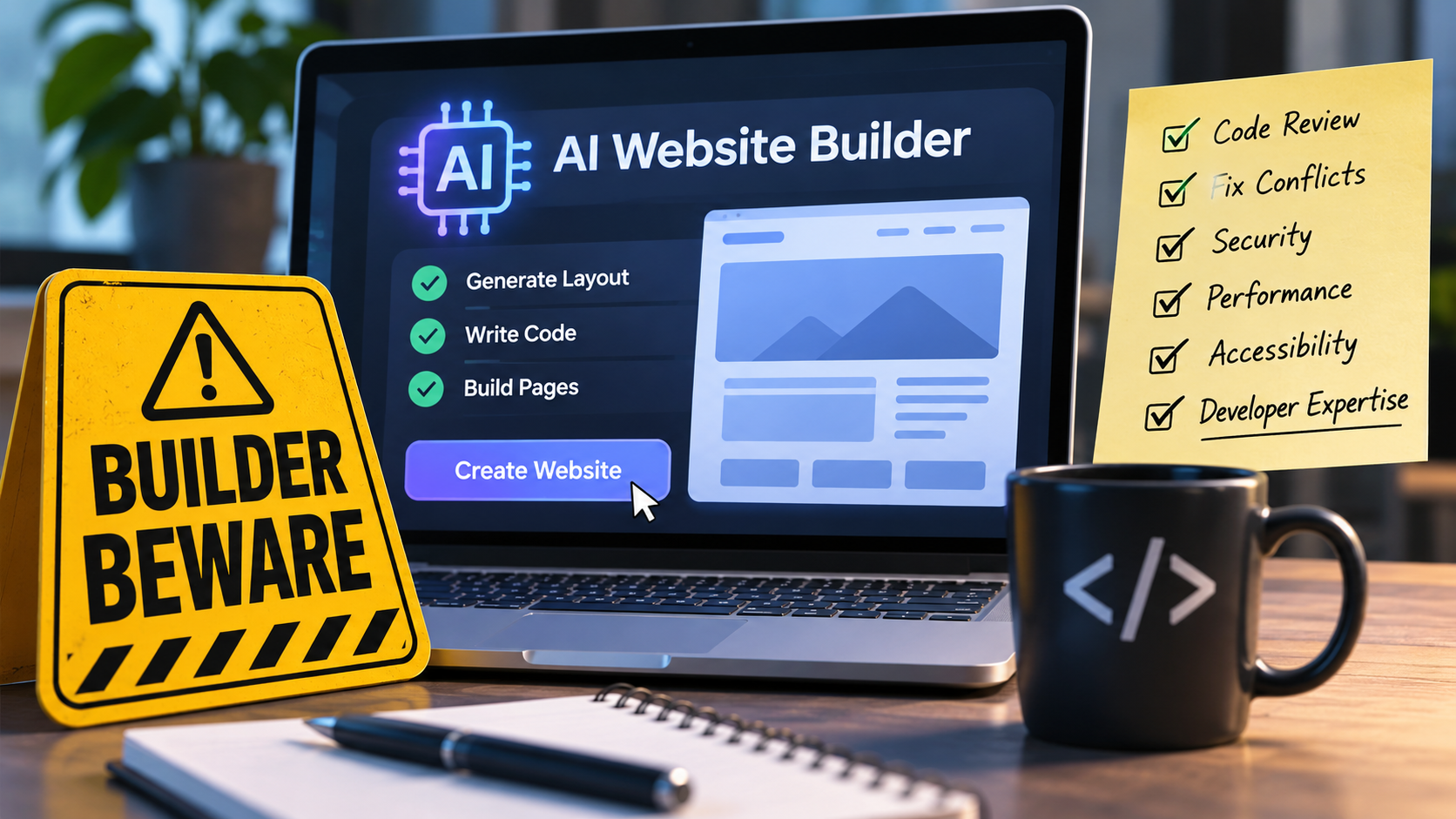
Artificial intelligence is changing how websites are built. But faster development doesn’t necessarily mean better development.
Artificial intelligence (AI) is quickly becoming one of the most popular tools in website development. From generating entire page layouts to writing HTML, CSS, JavaScript, and PHP, AI promises to make building websites faster, easier, and more affordable than ever before.
And to a certain extent, it delivers.
AI can generate code in seconds, suggest design improvements, troubleshoot errors, and automate repetitive development tasks. For business owners looking to establish an online presence, the idea of creating a website without hiring a professional developer is understandably appealing.
But there’s an important distinction between generating code and understanding how that code works.
That’s where things can get complicated.
AI Can Write Code. That Doesn’t Mean It’s Good Code.
One of the biggest misconceptions about AI-powered website development is that if the code works, it must be correct.
Unfortunately, that’s not always the case.
AI can produce code that looks perfectly reasonable but introduces unnecessary complexity, conflicts with existing functionality, or creates problems that aren’t immediately visible.
For example, you might ask AI to fix a navigation menu that isn’t displaying correctly on mobile devices. It generates some CSS, you paste it into your website, and the problem appears to be solved.
Great, right?
Not necessarily.
That same CSS might interfere with desktop navigation, override existing theme styles, or create accessibility issues. Ask AI to fix those new problems, and it may generate even more code that conflicts with the original solution.
Before long, what started as a simple adjustment becomes a collection of overlapping rules, unnecessary overrides, and temporary fixes.
A knowledgeable developer doesn’t just know how to make something work. They understand why it works, how it interacts with the rest of the website, and whether there’s a better way to accomplish the same result.
AI Doesn’t Always Understand the Bigger Picture
Modern websites are more than collections of individual pages.
They involve interconnected systems, including content management, databases, third-party integrations, security, performance optimization, responsive layouts, and accessibility.
A change to one component can affect several others.
AI is particularly useful when working with isolated problems. However, its recommendations depend heavily on the information and context it receives.
If AI doesn’t have a complete understanding of your website’s architecture, existing code, plugins, or custom functionality, it can recommend solutions that create more problems than they solve.
This becomes especially important with platforms like WordPress, where themes, plugins, custom functions, and core functionality must work together.
An AI-generated solution might technically accomplish the requested task while completely ignoring WordPress development standards or duplicating functionality that already exists.
An experienced developer recognizes those conflicts and understands when to use existing functionality rather than introducing unnecessary custom code.
The Problem With Fixing AI Mistakes Using More AI
Here’s a scenario that’s becoming increasingly common.
You ask AI to create a feature for your website. It provides code, but something doesn’t work correctly.
You explain the problem.
AI provides revised code.
That fixes the original issue but introduces another problem.
You ask for another correction.
Now you’re several revisions into what should have been a relatively straightforward task, and the code has become increasingly difficult to maintain.
Sound familiar?
AI doesn’t always recognize when its previous recommendations are contributing to the problem. It may continue adding new solutions instead of identifying the underlying conflict.
This is where understanding programming becomes essential.
A developer can examine the existing code, identify conflicting declarations, trace JavaScript behavior, review server-side errors, and determine the actual source of the issue.
Rather than continually layering fixes on top of fixes, they can address the problem at its source.
Sometimes the best solution isn’t adding more code. It’s removing code that never needed to be there in the first place.
Security, Performance, and Accessibility Still Matter
A website that looks good isn’t necessarily a well-built website.
Behind the design are technical considerations that directly affect how visitors experience your business online.
Security: AI-generated code can introduce vulnerabilities when it fails to properly validate input, sanitize data, escape output, or follow secure authentication practices.
Performance: Unnecessary scripts, inefficient database queries, excessive CSS, and poorly optimized assets can slow down a website. AI doesn’t always prioritize efficiency when generating a solution.
Accessibility: A visually appealing website can still be difficult or impossible for some visitors to navigate. Proper semantic HTML, keyboard navigation, screen reader compatibility, and accessible interactive elements require deliberate attention.
Search Engine Optimization: AI can help generate content and metadata, but technical SEO also depends on site structure, crawlability, internal linking, page performance, and proper implementation.
These aren’t details that should be treated as afterthoughts. They’re fundamental parts of professional website development.
Knowing What to Ask Is Only Half the Battle
AI is only as useful as the direction it receives and the ability of the person reviewing its output.
Someone with programming experience can provide precise instructions, recognize questionable recommendations, evaluate alternative approaches, and verify that the resulting code meets the project’s requirements.
Someone without that knowledge may have difficulty determining whether AI has produced an appropriate solution or simply something that appears to work.
This doesn’t mean business owners shouldn’t experiment with AI website builders. These tools can be excellent for creating prototypes, exploring ideas, and developing simple websites.
But as requirements become more complex, so do the consequences of decisions made without a solid technical foundation.
The ability to describe what you want a website to do is not the same as knowing how to build it properly.
AI Should Make Developers Better, Not Replace Them
At JF WebDesign, we see AI as another tool in the development process.
And it’s a useful one.
It can accelerate routine tasks, assist with troubleshooting, generate starting points for custom functionality, and help developers explore different approaches to solving problems.
But we don’t believe that generating code eliminates the need to understand it.
In fact, the increasing availability of AI-generated code makes experienced developers even more important.
Someone still needs to evaluate the output, identify mistakes, understand how different components interact, and make informed decisions about security, performance, maintainability, and long-term scalability.
A successful website isn’t measured by how quickly its code was generated. It’s measured by how well it performs, how effectively it serves its visitors, and how reliably it supports the business behind it.
The Bottom Line: Builder Beware
AI website development isn’t going away. The technology will continue improving, and the tools will become increasingly capable.
That’s a good thing.
But convenience shouldn’t be confused with expertise.
AI can help you build a website. It can write code, suggest layouts, and troubleshoot problems. What it cannot guarantee is that every recommendation is appropriate for your particular website or that the resulting code is secure, efficient, and maintainable.
That’s why understanding programming, website architecture, and development best practices remains so important.
Whether you’re using AI yourself or working with someone who uses it, make sure there’s real technical knowledge behind the finished product.
AI is a powerful tool. But a tool is only as effective as the person who knows how to use it.
Need More Than an AI-Generated Website?
At JF WebDesign, we combine years of hands-on web development experience with modern tools and technologies to build custom WordPress websites that are designed to perform, scale, and last.
We don’t just make websites look good. We understand the code behind them.